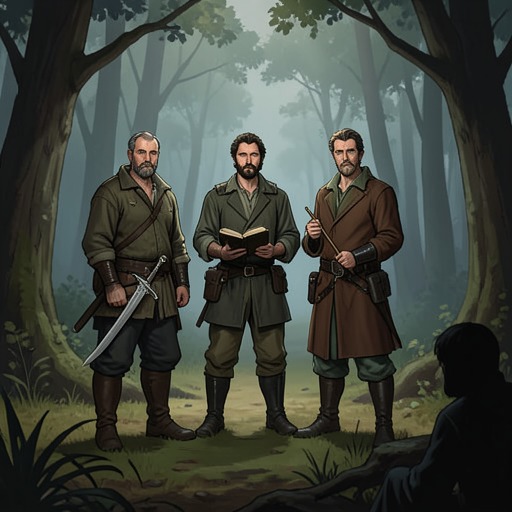
The three brothers evade Death by making a bridge
The Tales of Beedle the BardThe three brothers evade Death by making a bridge during their encounter with Death, turning a journey across a dangerous river into a contest over who can outwit mortality. Their magical escape wins them gifts, but the exchange also exposes the different desires that will shape each brother’s fate: domination, the recovery of the dead, and prudent withdrawal from danger.
The River Crossing
At twilight, three brothers travel along a lonely, winding road and come to a river too deep to wade through and too dangerous to swim across. Rather than risk drowning, they use their knowledge of magic: with a wave of their wands, they make a bridge appear over the treacherous water. The construction of the bridge changes the crossing from an impassable obstacle into a passage, but it also carries the brothers directly into Death’s path.
The brothers have reached the halfway point when a hooded figure blocks their way. The timing makes their escape precarious: they have avoided the ordinary danger of the river, yet are now face to face with the supernatural power that the river would have served. The bridge is at once their means of survival and the scene of their encounter with Death.
Death’s Offer
Death is angry because the brothers have cheated him of three new victims. The river, he explains, usually claims travellers who try to cross; the brothers’ spell has deprived him of the deaths he expected. Instead of attacking them, however, he conceals his anger beneath apparent generosity. He congratulates them on their skill and tells them that each has earned a prize for being clever enough to evade him.
The offer reverses the immediate balance of power. The brothers have outmaneuvered Death once, and Death answers by letting them choose gifts, but the prizes are shaped by the brothers’ own wishes rather than by any guarantee of safety. Their escape therefore becomes a test of judgment: each receives what he asks for, and each request gives a different form to his relation with death.
Three Prizes, Three Desires
The eldest brother is combative and seeks a wand more powerful than any other, one that will always win duels for its owner and suit a wizard who has conquered Death. Death crosses to an elder tree growing on the riverbank, fashions a wand from one of its hanging branches, and gives it to him. The prize translates the eldest brother’s appetite for conflict into an instrument of supremacy; even at the moment of escape, he imagines victory as lasting power over others.
The second brother is arrogant and wants to humiliate Death still further. He asks for the power to recall the dead, and Death picks up a stone from the riverbank, telling him it will bring the dead back. His request is not simply to survive Death’s presence but to reverse its work, making the recovery of the dead a means of defying the figure who has just confronted them.
The youngest brother is the most humble and the wisest. Distrusting Death, he asks not for greater power or for the dead to return, but for something that will let him leave without being followed. Death gives him his own Cloak of Invisibility, and does so most unwillingly. The youngest brother’s choice reframes success: rather than challenge Death or try to undo death, he seeks a way to pass beyond the encounter safely.
Departure and Significance
After handing over the gifts, Death stands aside and allows the brothers to continue. They cross onward, talking with wonder about their adventure and admiring what they have received. Their immediate escape is thus complete, but the gifts preserve the encounter’s contrast between the brothers’ responses: force, defiance, and cautious avoidance. They later separate, each bound for his own destination, carrying away a prize that reflects the desire with which he faced Death.
The episode makes cleverness the cause of the brothers’ survival, but it does not treat their escape as an uncomplicated triumph. Death’s anger gives his congratulations an edge of deception, while the brothers’ differing requests show that evading death and mastering it are not the same ambition. The bridge gets all three across the river; what each asks for on the bridge sets three distinct courses in motion.